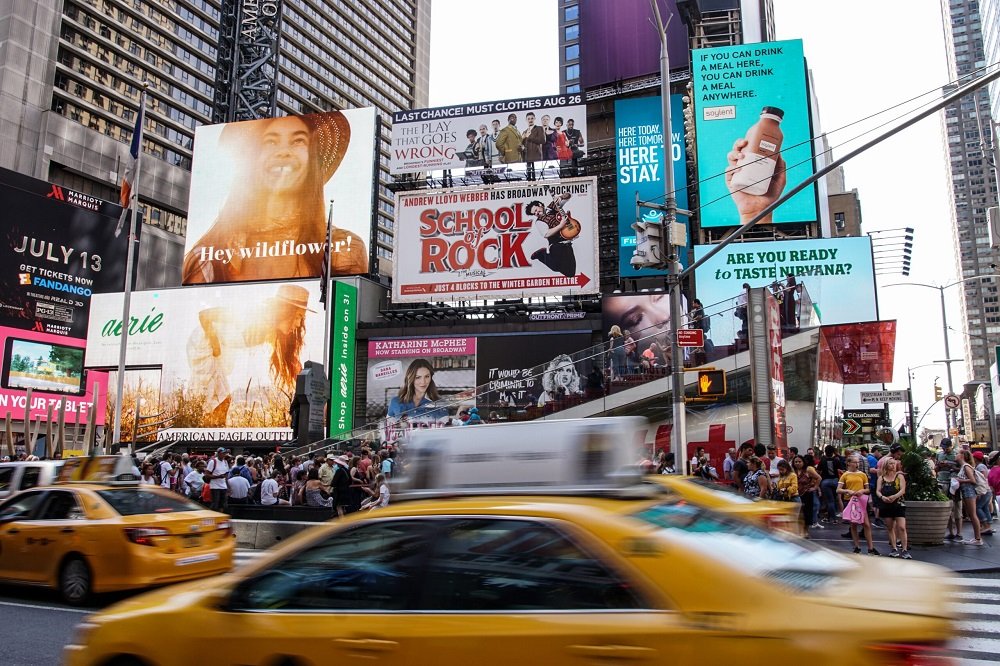
Experts predict 4 trends that will help out-of-home (OOH) advertising explode by 2025: The gap between online and offline attribution is narrowing, in-store media will make its mark,…

As traditional television gradually loses its appeal to young audiences, 2024 has witnessed a strong shift in the media landscape, with OOH/DOOH rising to assert its position as an important broadcasting medium.
While connected television (CTV) and video on demand (VOD) platforms have yet to completely replace the influence of linear television, OOH/DOOH has quickly filled the gap by leveraging its growing presence in urban and densely populated areas, giving brands the opportunity to reach millions of viewers on their daily journeys.
With the increasing deployment of digital screens and the incorporation of programmatic advertising strategies, the forecasted growth of more than 5% in 2025 shows that OOH/DOOH is ready to assert its leading role in the new media era.
Programmatic DOOH Will Continue to Expand for Advertisers
Programmatic digital out-of-home (pDOOH) advertising is opening up huge opportunities for both advertisers and media owners, driving creativity and data-driven customization in marketing campaigns. The rapid growth of pDOOH technology is making it easier for brands to tap into this market with more precise targeting, resulting in higher efficiency than traditional OOH advertising.


According to Adam Malone, President and Co-Founder of Screenverse, big changes are coming to the pDOOH space in 2025. He shares:
“Media owners can now activate dozens of screens in high-demand areas. By connecting to programmatic exchanges, they can start monetizing the first screens. This will create a significant opportunity over the next three to five years, especially with the emergence of more companies focused on specialized locations. pDOOH will continue to be a major growth driver, not only for media owners but also as a gateway for advertisers to experience the power of digital out-of-home advertising.”
Along with the explosion of pDOOH, advertisers are also looking for new ways to integrate digital out-of-home advertising with other media channels such as connected TV (CTV), an area expected to grow significantly by 2025. Mary Perrella, Vice President of Media and Marketing at Vengo Labs, said:
“2024 will see continued growth, and we expect OOH to play an even more important role in expanding the reach of CTV. By bringing campaigns from online spaces to physical locations, brands can deliver consistent messaging across both indoor and outdoor screens.”
The integration and synergy between pDOOH and other digital media channels will be a key trend as the industry fully exploits the potential of programmatic advertising.
The Gap Between Online and Offline Attribution Is Narrowing
The gap between measuring online and offline advertising effectiveness is narrowing as data and technology increasingly improve the ability to analyze and attribute results in OOH.
Ali Broback, Director of Clients and Partnerships at ODN Agency, notes that while tracking online results such as app downloads or web traffic has become simple, the big challenge today is accurately measuring the performance of OOH campaigns. She says:
“Brands and agencies understand that measuring performance is no longer an exception but a necessity in the OOH industry. While it’s easy to demonstrate impact like app downloads or increased web traffic, what will be more interesting next year will be how we can track actual impressions delivered after a campaign ends, rather than just relying on initial projections.”
In the same vein, Remco Dolman, CEO and founder of Spotzi, stressed the importance of using data to make OOH reflect the same precision targeting as online advertising. He shared:
“There’s a lot of data available – from footfall to transit data – and we can partner with brands and retailers to access their data. Out-of-home advertising is coming out of its silo and becoming more integrated with digital advertising, just as CTV is evolving.”
Jonathan Mark, CEO of Worldcom OOH in the US and Canada, believes that the use of data will continue to transform targeting in DOOH. He commented:
“We are moving closer to one-to-one connectivity in OOH. Looking at OTT (over-the-top) media, the focus is on targeting specific households. OOH is also increasingly leveraging data to optimize the ability to reach consumers at the most relevant time and place.”
The combination of data and technology is blurring the lines between online and OOH advertising, opening up huge potential for highly measurable and highly effective advertising campaigns.
Sustainability in media continues to be a priority
Sustainability is becoming a key focus for the media industry, reflecting a strong shift towards environmentally responsible creative solutions and products. To meet this demand, many agencies are looking for ways to plan and execute more sustainable media campaigns. Stephanie Scheller, Managing Partner of Sustainable Solutions EMEA at Omnicom Media Group (OMG), says the group has taken a big step by establishing a sustainability consultancy, bringing together a team of environmental experts. By combining this expertise with OMG’s media experience, they aim to deliver solutions that are both sustainable and ensure optimal marketing effectiveness. She shares:
“Our primary goal is effective media planning. You can have the greenest strategy, but if you don’t reach the right audience, you’re just creating unnecessary carbon emissions. We help advertisers make decisions that balance sustainability and impact.”
To make this happen, Omnicom has developed innovative tools to optimize communications strategies based on both traditional key performance indicators (KPIs) and carbon emissions, allowing for environmentally friendly options without sacrificing campaign effectiveness.

Experts agree that by 2025, more brands and agencies will prioritize working with media partners that adopt sustainable practices, such as using renewable energy or recycled materials to reduce carbon. As new regulations turn sustainability from a “nice-to-have” to a “must-have,” change management and education will play a key role in helping customers and stakeholders adapt to these rising expectations and demands.
In-store media will make a big impact
According to eMarketer, by 2025, retail media is expected to account for two-thirds of the $67 billion in total media spend. This trend is driving strong growth in in-store retail media, as media networks expand and retailers look to diversify revenue streams and optimize the experience both in-store and online. In-person shopping still plays an important role in the shopping journey, encouraging brands to reach customers with more relevant and engaging messaging.

Jonathan Franco, Director of Sales, Retail Media at Broadsign, envisions physical stores transforming into dynamic multi-media environments. He sees granular data helping retailers refine their marketing strategies, improve store layouts, manage inventory, and unlock the potential of programmatic bidding for digital advertising. Franco shares:
“Retail media buying automation will grow rapidly, allowing advertisers to optimize campaign placement and performance across both digital and physical spaces while maintaining control. AI will be at the center, helping refine strategies, optimize allocation, and adjust messaging in real time for higher ROI.”
Franco also emphasizes the importance of combining physical and digital experiences, creating a seamless omnichannel model that connects consumers with brands at every touchpoint. “Retailers have an opportunity to blur the lines between shopping and content consumption, turning the store into a media space where every touchpoint is an opportunity for interaction,” he said.

Adam Malone, President of Screenverse, added that data integration is key to getting the most out of digital screens in and around stores. Rather than just playing video, he emphasized leveraging behavioral and contextual data from CPG brands to maximize advertising impact.
Looking ahead, 2025 is expected to be a watershed year for OOH advertising. Advances in programmatic, tighter integration with digital channels like CTV, and the rise of innovative formats will continue to elevate the out-of-home medium. Automation and data analytics will not only bring clear measurement capabilities, but also open up new and meaningful ways to connect with consumers.
Dieu Anh (According to Broadsign)